


The store matters more, and so does your data: five takeaways from FT Future of Retail 2026

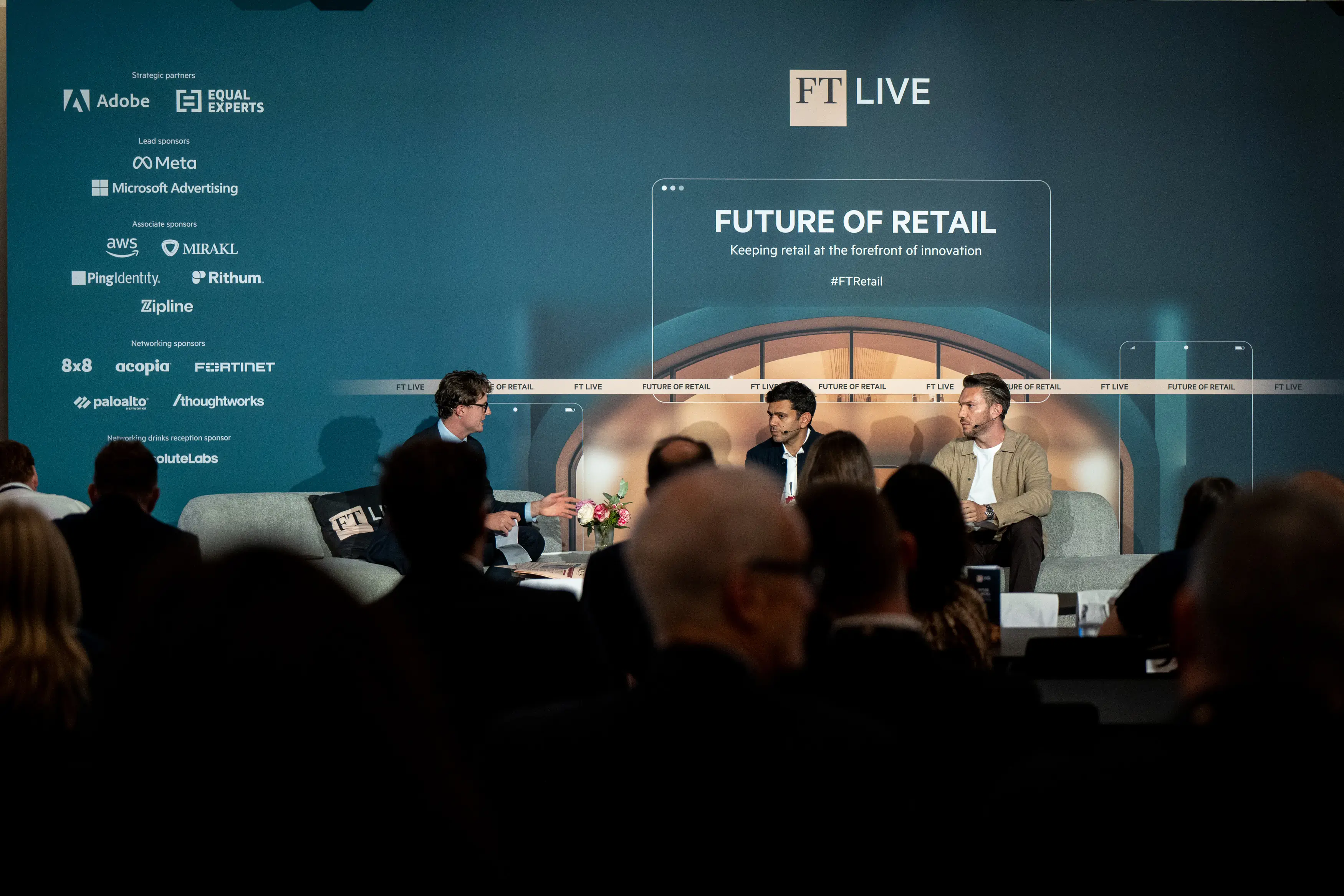
One of the UK’s best-known high-street chains stopped selling online this year, and its sales are up. That was just one of the decisions behind the conversation at FT Live’s Future of Retail summit in London on 6 October. The British Retail Consortium estimates retail employment costs have risen by £6.5bn in two years, while the sector has 122,000 fewer jobs. Shoppers are still cautious, and as B&Q CEO Graham Bell put it, “since the Covid pandemic volatility is the new norm.”
Against that backdrop, the conversation wasn’t about the next big idea. It was about where the money and attention should actually go. AbsoluteLabs spent the day on the stand and hosted the evening drinks, and these are the five things we took away.
.jpg)
.jpg)
.jpg)
1. The store is changing its job, not losing it
JD Group CEO Régis Schultz made the strongest case of the day for physical retail. “Humans are social animals,” he said. “We want to serve that need and give instant gratification, online can never do that.” JD is going for bigger stores, with in-store cafés, barbers and till checkout in under a minute. It is also candid that its 15-20% in-store conversion rate “can be better.”
Notably, Schultz argued the store should be an alternative to online rather than a copy of it. Dunelm CEO Clodagh Moriarty took a different line: “You’ve got the physical reach, you’ve got the digital reach, you’ve got to bring them together.”
Our take: both can be right, because they’re answering different questions. Schultz is talking about the experience, Moriarty about the operation behind it. A store can feel completely different from the website and still run on the same stock, orders and customer data. That’s when it can do its new job well.
2. Online has to earn its place
The most striking decision discussed on stage came from The Works. In March it stopped selling online, and its website is now a browse-only shop window for its 500 stores. Gavin Peck explained that online was less than 10% of sales and losing money. “Our typical £1.50 margins make it difficult online,” he said. “We’ve invested the money in pricing instead.” He didn’t rule out a return once The Works’ data is in better shape.
Sweaty Betty showed the other side. Melissa Mullen, CEO, said “consumers that shop across our multi channels are five times more valuable,” and the brand ran 1,400 in-store events last year.
Our take: these aren’t opposite strategies. They’re the same discipline applied to different businesses. The question isn’t “store or online?” It’s whether each channel pays its way for your customers. Most retailers can’t answer that with confidence until their channel data lines up.
3. AI is paying off in the unglamorous places first
The panel spoke less about AI as a headline and more about where it already works. Graham Bell said B&Q uses AI for forecasting and that, in sourcing and shipping, it can make routing faster and cheaper. Melissa Mullen said AI can “remove the gruntwork from design and speed up creativity.”
Our take: that matches what we see. The first returns rarely come from the showcase project. They come from repetitive, high-volume work behind the scenes, where the process is clear and the result is easy to measure.
4. Your next customer might be an AI agent, and it won’t wait
The agentic commerce panel brought the sharpest warnings of the day. “AI agents are inherently lazy, so if you’re too hard to find they will just move on,” said Matt Berzinski of Ping Identity. Philip Hall of Rithum put it more simply: “Your product page is your new home page.” He also warned that AI tools “will tend to direct you to the cheapest price.”
Brands are already responding. L’Oréal Europe’s Othman Bennis said the business is moving from 18–20 product data fields to hundreds. Wolf & Badger says it was the first retailer in Europe to take an order started by an AI agent, and CEO George Graham said: “We are already transacting.” B&Q has signed a major contract with Google to improve its data and discoverability for AI agents.
Our take: this is the point where product and customer data stops being a back-office issue and becomes a sales channel. If an agent can’t read your range, stock and prices, it can’t recommend you. The retailers that win early won’t necessarily have the cleverest AI. They’ll have the cleanest, most connected data.
5. The fundamentals haven’t changed
For all the talk of agents, some of the most grounded comments came from the people furthest ahead. Even as Wolf & Badger takes orders from AI agents, George Graham stressed that it is very early days, and that “the fundamentals don’t change.” Schultz said much the same about JD: “it’s just a question of right product, at the right price.”
Our take: that’s the right note to end on. Technology doesn’t replace good retailing. It makes good retailing possible at scale, as long as the systems underneath can keep up.
What it means for 2027
Put together, the day pointed to a simple brief for the year ahead: give the store a clear job, make every channel earn its place, put AI where the returns are proven, and get your data ready for customers who might not be human.
The last of those is the one most retailers are least prepared for, and it’s where we expect the gap between leaders and the rest to open up fastest.
Thank you to everyone who visited our stand and joined us for drinks.




%20Medium.jpeg)


.jpg)




.jpg)



.jpg)


.jpg)




.jpeg)



